I've Been Thinking a Lot About Waiting
I've been thinking a lot about waiting lately. Not the dramatic kind. The ordinary kind. Waiting for a build to finish. Waiting for someone in procurement to decide whether a tool I needed last month can be approved this month. Waiting for a security review. Waiting for legal. Waiting for a meeting to start because everyone is still hunting for the HDMI cable. Waiting for a colleague to come back from holiday, because of course the one answer I need is locked inside their head and nowhere else. Waiting because somebody marked an email High Importance, apparently unaware that Outlook still has no button labelled "ignore until tomorrow, this is not actually important."
If you added all of that up over a single week, it would come to hours rather than minutes. We just don't experience it that way, because waiting hides. It disappears into the spaces between the things we think of as the real work, and most organisations have quietly agreed to treat that vanished time as a law of nature, like weather. Nobody budgets for it. Everybody absorbs it.
I never absorbed it very well.
This is not a virtue, and I want to say that before the story turns into one about discipline, because it isn't one. Waiting simply bothered me. If something else could move while I was blocked, it felt almost physically wrong to let it sit still. Looking back, I don't think I was trying to be more productive. I was allergic to idle capacity, which is a different thing, and a slightly less flattering one.
So I never became good at waiting. I became good at finding something else to do. If a customer needed half an hour to test a configuration, I switched to another customer. If a script was working its patient way through fifty thousand objects, I wrote documentation or answered email. If I was stuck in a meeting that could have been a paragraph, I would usually walk out of it with two or three ideas for fixing some internal process nobody had asked me to touch.
That last habit is the one worth admitting to, because it isn't really about waiting at all.
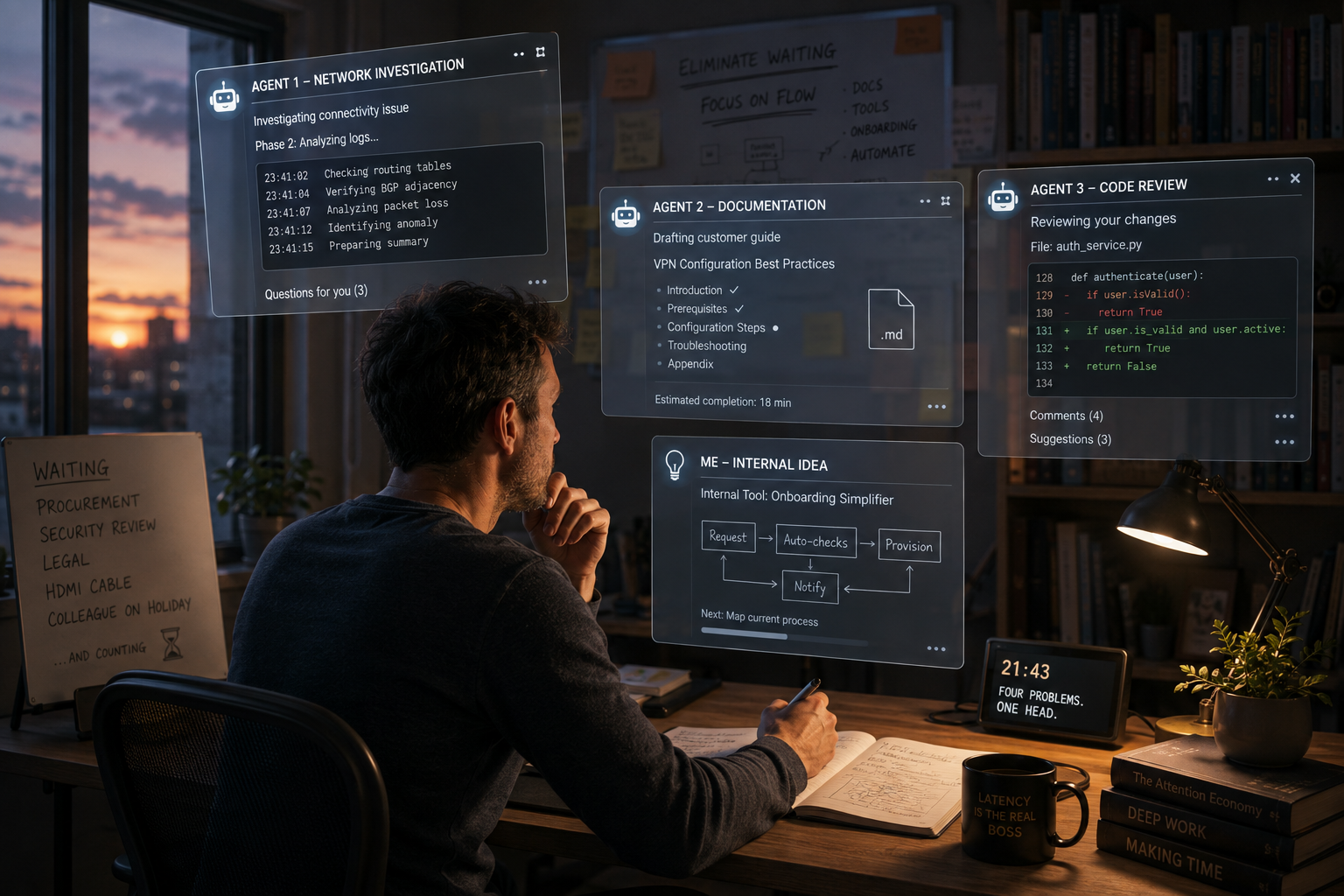
There has always been a second queue running somewhere in the back of my head. The customer work paid the bills and got my attention, but underneath it there was usually a script that deserved refactoring, a piece of documentation that could be clearer, an onboarding process that could lose six steps without anyone noticing, or some internal tool that didn't exist yet but obviously should. I spent years assuming this was simply what it felt like to have a job. Then I started comparing notes with colleagues and discovered that not everyone walks past a clumsy process and feels personally summoned to repair it. For a lot of people, a slow process is just a slow process. For me it has always been a small open tab that refuses to close.
I'm describing this in detail because it turns out to matter more than any of the productivity language I would normally reach for. It isn't a technique. It's closer to a personality trait, and possibly not an entirely healthy one. But it is mine, and it has shaped every working day I can remember, long before anyone was talking about agents.
Which brings me, eventually, to AI.
Last week I caught myself running three customer engagements at the same time. One agent was investigating a networking issue and coming back every so often with questions. Another was drafting documentation for a different customer entirely. A third was reviewing code I'd written that morning and, with no particular tact, finding several ways to improve it. While all of that ran, I was sketching an internal idea that has been sitting in the back of my head for months.
At first glance, that is precisely the future everyone keeps writing about. One person, several tireless assistants, work happening in parallel. And for a moment I believed it too, until I sat with it a little longer and realised I had been working almost exactly like this for fifteen years.
The agents are new. The workflow isn't.
That sentence bothered me for a couple of days. It arrived sounding clever, and I've learned to distrust sentences that sound clever the first time I write them, because most of them quietly fall apart overnight. This one didn't. If anything it got worse, because if the workflow really isn't new, then AI hasn't transformed me the way the articles promise. It has just revealed something that was already there. That is a less comfortable story. The comfortable version lets me be someone who adapted. This one suggests I didn't adapt to anything. I simply got tools fast enough to keep up with how I had always wanted to work.
The more I looked, the more the old pattern showed through. Instead of waiting for a customer to reply, I now wait for an agent to finish reading a log file. Instead of waiting for a script, I wait for a model to review a document, or to explain why the solution I was rather proud of an hour ago is not as elegant as I'd decided. The bottleneck moved. The shape of the day did not.
But here is the part I keep turning over. AI only removed one kind of waiting. It did nothing at all about the others. Procurement is exactly as slow as it was. Security review has not accelerated. Legal still takes the time legal takes. The colleague on holiday is still on holiday, and the HDMI cable is still missing. My career, when I'm honest about it, has mostly been an exercise in navigating other people's latency, and AI has only touched the small technical corner of that. The rest is as human and as immovable as ever. So the relief is real, but it is partial, and the partialness is its own kind of strange.
What did change, undeniably, is rhythm.
Ten years ago I switched context every twenty or thirty minutes, which was long enough to actually fall into a problem before climbing out of it for the next one. The day had a cadence, because every task came with pauses I couldn't avoid. Customers went to lunch. Scripts finished when they finished. Meetings ended. There were small dead moments where nothing demanded anything of me, and I didn't value them at the time because I didn't know they were doing anything.
Those pauses are mostly gone now. The customer is still thinking, but the model has already answered. The script is still running, but the review is already done. Another document is ready, another suggestion has surfaced, another reasonable question is waiting politely for attention. The gaps between interruptions have collapsed, and I'm not sure we've taken the measure of what that does to a person.
We talk about AI making us more productive, which is true. We talk less about the fact that it also raises the density of interruption, which is a clinical way of describing something everyone recognises the moment they feel it. It is like having your inbox replaced by an extremely capable colleague who means well, who is usually right, and who taps you on the shoulder every few minutes to say there's one more thing you might want to look at. And the maddening part is that there usually is. The suggestion helps. The review catches the real bug. The summary saves twenty minutes. It isn't noise. It's good work. There is just far more of it arriving, far faster, than there used to be.
For most of my career, the expensive part of the job was never the producing. Typing was cheap. Thinking was expensive. Attention was expensive. Judgement was expensive. AI has made the cheap part nearly free and left the expensive part exactly where it was, which means the question quietly shifted from how fast I can make something to how fast I can take in, weigh and prioritise everything that comes back. We automated the waiting and accidentally made human attention the scarcest thing in the room.
I think this is where most of the confusion in these conversations actually lives. We keep asking whether AI changes how people work, as though everyone is starting from the same place. We aren't. Someone who naturally worked one task at a time now finds themselves with several parallel workers, and that genuinely is a new way of working for them. Someone who had already spent years squeezing the idle time out of their day doesn't get parallel workers, because they already had those. They get something stranger. They get the idle time itself removed. Those are not the same experience, and no amount of talking about prompts or model rankings closes the gap between them. AI didn't hand everyone the same upgrade. It amplified whatever each of us was already doing, which means the people it changed most are the ones who worked least like this before.
This is usually where the essay is supposed to turn wise and tell you that the real lesson is learning when to stop. It's a tidy ending, and I don't believe it, at least not about myself, so I won't pretend to.
The truth is I like this. I like having several threads alive at once. I like the feeling of three problems simmering while I think about a fourth. The tiredness at the end of the day is real, but it isn't the tiredness of doing something wrong, or of failing to set a boundary I keep promising to set. It is the tiredness of reaching the actual ceiling of my own attention. For twenty years, waiting kept me below that ceiling without my consent and without my noticing. There was always a pause coming, whether I wanted one or not. AI took the pauses away, and what's left is just me and the limit of how much I can hold in my head at once. That isn't a discipline problem. It is a more interesting and far less solvable one, and we keep mistaking the two for each other.
For years I thought I'd simply gotten better at multitasking. Then I thought AI had taught me to orchestrate parallel work. Now I suspect neither is true. Perhaps I've spent twenty years trying to eliminate waiting without ever noticing that the waiting was quietly protecting me from myself.
That thought has stayed with me far longer than any benchmark, any model release, or any announcement from yet another conference. Maybe because technology rarely changes who we are. More often it just reveals who we already were when nobody was watching closely. And perhaps that is why AI feels revolutionary to some people, oddly familiar to others, and quietly exhausting to nearly everyone. Not because it invented a new way of working. Because it removed the space that used to sit between the things we were already trying to do.